WWUNDERHUB

WunderHub / Articles

Ideas for
what’s next.

Notes on making AI perform inside the real enterprise.

Search by title, subject, content, topic, or hashtag.

Browse topics

3 posts

SaaS Sprawl Is a Tax on Growth: How Enterprise Software Consolidation Funds Your AI Roadmap

WunderHub note

SaaS Sprawl Is a Tax on Growth: How Enterprise Software Consolidation Funds Your AI Roadmap

SaaS Sprawl Is a Tax on Growth: How Enterprise Software Consolidation Funds Your AI Roadmap

Abstract enterprise software landscape showing fragmented SaaS systems, disconnected data nodes, and integration overhead

Enterprise software sprawl is no longer an IT inconvenience. It is a direct tax on growth.

Every fragmented SaaS subscription creates four costs:

  • License expense.
  • Integration overhead.
  • Data fragmentation.
  • Technical debt.

The invoice shows only the first.

The other three appear in delayed reporting, duplicate records, manual reconciliation, security exposure, and stalled automation. Finance pays for software. Operations pays for friction. IT pays for complexity. The enterprise pays everywhere.

AI makes this problem fatal.

AI cannot create reliable enterprise intelligence from disconnected systems. It cannot reason across duplicated data, fragmented workflows, and inconsistent permissions. Adding an AI assistant to every existing application does not solve the operating model. It creates another layer of fragmentation.

The answer is not more software.

The answer is disciplined SaaS sprawl reduction, decisive enterprise software consolidation, and a unified data platform that turns technology spend into reusable operating infrastructure.

Insight 01: SaaS sprawl is an operating tax, not a procurement problem

Most application portfolios were never designed. They accumulated.

A department needed a capability. Someone purchased a tool. Another team purchased a similar tool. Integration followed. Data duplicated. Users created workarounds. The business accepted the complexity because each decision appeared rational in isolation.

The portfolio became irrational as a whole.

This is the core failure. Enterprise leaders review individual renewals instead of the operating system created by the entire portfolio.

The true cost of a SaaS application includes:

  • Annual licenses and premium add-ons.
  • Implementation and configuration.
  • Integration development and maintenance.
  • User administration and access management.
  • Data synchronization and reconciliation.
  • Security and compliance review.
  • Training and change management.
  • Reporting across inconsistent systems.
  • Exit costs when the business finally retires the tool.

A $100,000 subscription can generate several times that amount in operating obligations.

This is why SaaS sprawl reduction must begin with economics. The question is not, “Does this application have users?”

The question is, “Does this application create enough differentiated value to justify its total operating cost?”

That is a CFO question. It is also a CIO question.

Insight 02: AI exposes the weakness of fragmented architecture

Traditional automation could survive fragmentation.

A team could automate one step inside one system. The result looked productive. The enterprise still carried the underlying handoffs, duplicate records, and disconnected decisions.

AI changes the standard.

AI depends on context. Context depends on connected data. Connected data depends on shared models, governed access, and coherent workflows.

A fragmented application estate breaks the chain.

The agent cannot determine which customer record is authoritative. It cannot trust conflicting financial data. It cannot execute a cross-functional workflow without navigating multiple identity models and brittle integrations. It cannot understand an operational process that exists partly in an ERP, partly in email, partly in spreadsheets, and partly in employee memory.

The enterprise then blames the model.

The model is not the problem. The foundation is.

Abstract visualization of five structured application rationalization decisions represented as orderly connected cards

An AI layer bolted onto fragmented software is technology theatre. It creates activity without creating operating leverage.

An AI-native operating platform does the opposite. It embeds intelligence into the workflows, data structures, controls, and decisions that run the business.

That distinction determines whether AI becomes a growth engine or another cost center.

Insight 03: Rationalize the portfolio with five hard verdicts

Application rationalization requires decisions. Not observations. Not another inventory. Decisions.

WunderHub uses five verdicts to evaluate an application through an AI-era lens:

1. Keep

Keep systems that provide strategic, differentiated value.

The application must have strong adoption, clear ownership, defensible capability, acceptable risk, and a viable role in the future architecture.

“People use it” is not enough. Strategic value must survive financial and architectural scrutiny.

2. Consolidate

Consolidate duplicate capabilities.

Multiple project tools, service platforms, analytics products, collaboration systems, or workflow engines create unnecessary cost and inconsistent data. Select the enterprise standard. Migrate dependent teams. Remove the duplicates.

Consolidation creates immediate savings. It also reduces the number of systems that future AI initiatives must understand.

3. Replace

Replace applications when a stronger enterprise capability already exists.

The replacement may come from an existing strategic platform, a Microsoft capability, an industry operating system, or a unified AI-native platform. The objective is not to preserve historical purchasing decisions. The objective is to establish the best operating foundation for the next decade.

4. Agent-enable

Keep the system of record. Remove the friction around it.

Some applications contain critical transactional history or specialized functionality. Replacing them creates unnecessary risk. Agent-enable them instead.

Use governed agents to handle document processing, approvals, routing, recommendations, exception management, and natural-language access. Preserve the record. Redesign the work.

5. Retire

Retire applications that no longer create sufficient value.

Low usage, high cost, redundant capability, weak controls, and poor data quality are retirement signals. Sentiment is not a business case. Legacy status is not a strategic exemption.

Every retirement should include a migration plan, an owner, a decommission date, and a measured benefit.

The verdict is simple. Keep, Consolidate, Replace, Agent-enable, or Retire.

Anything else is delay.

Read the full AI Application Rationalization framework.

Insight 04: Consolidation funds the AI roadmap

AI programs fail when leaders treat them as additional spending.

The CFO sees rising license costs, consulting fees, cloud consumption, and internal labor. The board sees pilots without measurable returns. The CIO sees more integration, more governance, and more security exposure.

The AI roadmap becomes vulnerable before it reaches production.

Enterprise software consolidation changes the funding model.

Retiring duplicate applications releases license expense. Removing middleware reduces maintenance. Standardizing workflows reduces manual reconciliation. Centralizing data reduces reporting labor. Consolidating contracts improves procurement leverage.

The released capacity funds higher-value AI work.

This is the financial logic:

  1. Establish the current application and operating baseline.
  2. Identify duplicate functionality and unnecessary integrations.
  3. Assign each application one of the five rationalization verdicts.
  4. Quantify license, labor, integration, risk, and transition costs.
  5. Capture savings through contract action and decommissioning.
  6. Reinvest the realized value into governed AI capabilities.

This is not cost cutting for its own sake.

It is capital reallocation from fragmented rental expense to owned enterprise capability.

WunderHub’s AI Value Realization Sprint uses this same discipline. It ties AI investment to revenue, cost, capacity, cycle time, risk, customer experience, and decision quality.

AI activity is not value. A deployed license is not value. A pilot is not value.

Value appears when the workflow changes and the baseline improves.

Insight 05: The unified data platform becomes the enterprise control point

Consolidation without data architecture creates a cleaner mess.

The enterprise needs a unified data platform that establishes trusted records, shared semantic models, governed documents, transactional context, and consistent access controls.

This does not mean forcing every workload into one database. It means creating one operating foundation for how data is defined, connected, governed, and used.

The foundation must answer basic questions with precision:

  • Which system owns the customer record?
  • Which data defines revenue?
  • Which workflow controls approval?
  • Who can access sensitive information?
  • Which agent can act?
  • Where does human approval remain mandatory?
  • How does the organization measure output quality?

Without these answers, AI produces confident inconsistency.
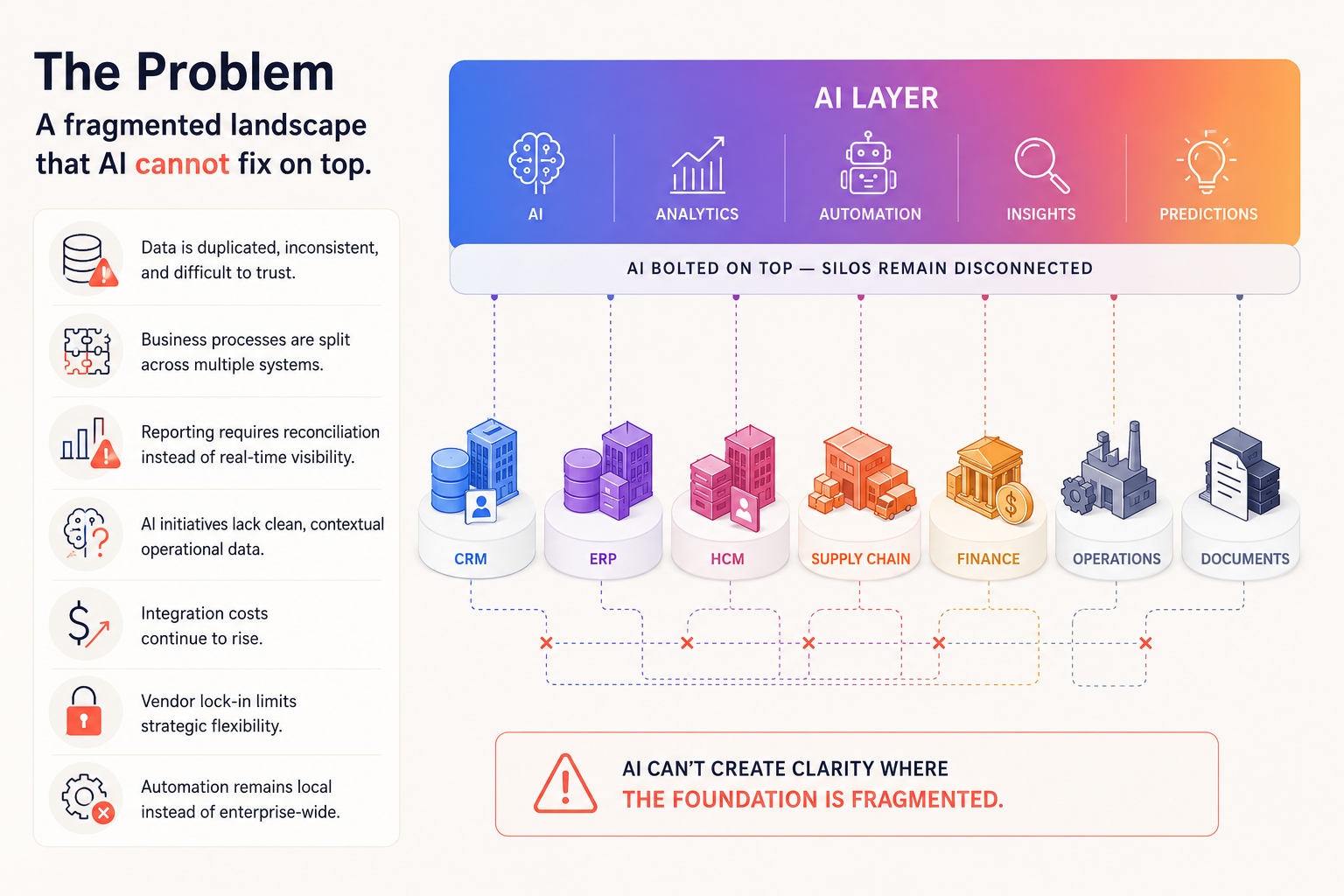
Abstract fragmented enterprise architecture with disconnected CRM, ERP, finance, operations, and document silos

OrgOS™ positions the Unified Operational Data Foundation as the core of AI readiness. It connects people, work, customers, finance, content, assets, and intelligence into one operating model.

That architecture creates compounding returns.

Each new workflow benefits from the same data foundation. Each new agent benefits from the same identity and governance model. Each new insight benefits from the same operational context.

The cost of the next AI capability declines because the enterprise stops rebuilding the foundation.

Insight 06: Five value pillars determine whether consolidation creates results

Enterprise software consolidation must connect to an operating model. Five value pillars make that connection explicit.

Value

Start with a measurable baseline.

Track cost, capacity, cycle time, risk, revenue, and service quality. Fund initiatives that change the baseline. Stop initiatives that do not.

Workflows

Redesign the work.

Automation applied to a broken process creates faster dysfunction. Define what humans should own, what agents should reason through, what automation should execute, and where exceptions require judgment.

Agents

Put governed agents inside real operations.

Agents must have defined responsibilities, access boundaries, escalation rules, owners, and performance measures. An agent without governance is an uncontrolled employee with system access.

Governance

Control the lifecycle.

Governance covers identity, permissions, data boundaries, evaluation, monitoring, incident response, approval thresholds, and retirement. Build it before deployment. Do not wait for an audit or failure.

Foundation

Build reusable architecture.

Trusted data, semantic models, shared knowledge, workflow services, and reference architecture make every subsequent AI investment faster and cheaper.

These pillars are not presentation language. They are operating requirements.

WunderHub’s AI-native operating model connects them into an execution framework.

Insight 07: The end state is owned intelligence

The goal is not to own fewer applications.

The goal is to own a more intelligent enterprise.

A consolidated operating platform should give executives a unified view of performance. It should connect decisions to workflows. It should make data available in context. It should allow governed agents to act across functions. It should reduce dependence on manual coordination and vendor-specific silos.

That is the purpose of OrgOS™.

It is not another point solution. It is an operating foundation for integrating people, data, workflows, intelligence, and decisions. Organizations can use standalone products, replace legacy platforms, or build a unified AI platform around the framework.

The strategic choice is clear:

  • Point solutions rent isolated capabilities.
  • Consolidated platforms build reusable infrastructure.
  • AI-added tools improve tasks.
  • AI-first operating models improve how the enterprise works.
  • Fragmentation multiplies cost.
  • Unity compounds intelligence.

The enterprise technology model has reached its breaking point. More subscriptions will not repair it. More integrations will not simplify it. More AI pilots will not create value on top of disconnected operations.

Start with the portfolio. Apply the five verdicts. Build the unified data platform. Reinvest the savings.

Stop treating SaaS sprawl as a procurement leak.

Treat it as the funding source for your AI roadmap. Build the operating foundation your enterprise will own, govern, and compound.

Predictive Maintenance Isn't a Pilot Anymore: How AI Is Rewiring the Factory Floor

WunderHub note

Predictive Maintenance Isn't a Pilot Anymore: How AI Is Rewiring the Factory Floor

Predictive Maintenance Isn't a Pilot Anymore: How AI Is Rewiring the Factory Floor

Luminous abstract visualization of connected manufacturing assets, operational data, and industrial AI

Predictive maintenance has crossed the experimentation threshold.

It is no longer a science project for the innovation team. It is no longer a dashboard installed on three machines for a quarterly presentation. It is now a board-level operating priority.

The reason is simple. Unplanned downtime destroys throughput, margin, customer commitments, and workforce capacity. Preventive maintenance reduces some risk. Predictive maintenance changes the timing, precision, and economics of intervention.

The market has moved from asking whether AI can predict equipment failure to asking whether the enterprise can operationalize those predictions across plants, assets, workflows, and people.

That is the real agenda for AI for manufacturing operations.

Insight 01: The pilot phase is ending

The 2026 manufacturing conversation has changed.

Rockwell Automation’s 2026 State of Smart Manufacturing research reports that 59% of manufacturers actively use smart manufacturing technologies in operations. Only 18% remain in pilot mode. One-third of operations are already AI-augmented.

That is not theoretical adoption. It is operational deployment.

Cisco’s 2026 State of Industrial AI Report reaches the same conclusion from another angle. Sixty-one percent of industrial organizations now use AI in live operational environments. Twenty percent report scaled, mature deployments.

The message is clear:

  • AI experimentation is common.
  • Live deployment is accelerating.
  • Enterprise-scale execution remains rare.
  • Infrastructure and operating models now determine the winners.

A pilot proves possibility. Production proves value.

Manufacturers that continue to treat predictive maintenance as a limited pilot will lose time, data, and competitive position. The strategic question is no longer, “Can the model identify a failing bearing?” The question is, “Can the organization convert that prediction into a safe, prioritized, completed maintenance action across every relevant site?”

That requires a system.

Insight 02: Predictive maintenance is a workflow, not a model

A model generates a probability. Operations require a decision.

A useful predictive maintenance capability must connect five events:

  1. Sense equipment conditions through sensors, controllers, historians, and industrial systems.
  2. Interpret signals against asset history, production context, and known failure modes.
  3. Prioritize the risk based on business impact, safety, production schedules, and available resources.
  4. Act through a maintenance plan, work order, spare-parts request, escalation, or inspection.
  5. Learn from the technician’s outcome and the asset’s subsequent performance.

Most failed pilots stop at step two.

The plant receives an alert. The alert enters a separate dashboard. A reliability engineer reviews it when time permits. The maintenance planner checks another system. The technician receives incomplete context. The work order lacks the model’s reasoning. The organization then calls the pilot inaccurate.

The model did not fail. The operating design failed.

Predictive maintenance only creates value when intelligence enters the flow of work. It must appear where planners, supervisors, reliability engineers, and technicians already make decisions. It must include asset identity, failure mode, confidence, lead time, recommended action, required parts, and accountable ownership.

The output cannot be “machine health: 72%.”

The output must be: “Inspect pump P-204 within 48 hours. Vibration signature indicates a developing bearing failure. Production impact is high. Part availability is confirmed. Reliability engineer approval required.”

That is operational intelligence. Everything else is technology theatre.

Abstract visualization of predictive maintenance signals moving through a precise operational grid

Insight 03: The OT/IT divide has become the breaking point

Manufacturing data exists everywhere. It rarely works together.

Operational technology captures machine states, vibration, temperature, pressure, current, cycle time, alarms, and process conditions. Information technology manages work orders, asset records, inventory, procurement, production schedules, costs, quality records, and enterprise reporting.

These systems often use different identifiers, formats, ownership rules, security models, and update cycles.

The result is a fractured asset record.

The sensor stream identifies one machine. The CMMS uses another name. The ERP stores a different location. The production system assigns a separate line identifier. The maintenance history sits in a spreadsheet. The technician holds the most accurate context in personal experience.

AI cannot reason reliably across that mess.

KPMG’s Intelligent manufacturing: A blueprint for creating value through AI-driven transformation identifies fragmented data, legacy systems, interoperability, and workforce readiness as central barriers to AI value. Its operating model moves through three stages: enable people and foundations, embed AI in workflows, and evolve the enterprise.

That sequence matters. Manufacturers cannot skip the foundation.

The required foundation includes:

  • A common asset hierarchy.
  • Consistent equipment identifiers.
  • Standardized failure codes.
  • Trusted maintenance history.
  • Connected sensor and production data.
  • Governed access across OT and IT.
  • Clear ownership for data quality.
  • Integration between AI outputs and maintenance execution.

Cisco’s research reinforces the infrastructure risk. Forty percent of industrial organizations cite cybersecurity as the biggest obstacle to scaling AI. Forty-three percent report limited or no IT/OT collaboration. Among organizations with weak collaboration, network instability becomes a major operational constraint.

This is not an architecture detail. It is a production risk.

AI at the factory edge requires secure connectivity, predictable latency, segmentation, observability, and disciplined control over data flows. The organization must connect OT and IT without turning the plant floor into an uncontrolled extension of the corporate network.

Insight 04: Operational excellence is the business case

Executives should not fund predictive maintenance because the model is impressive.

They should fund it because it improves measurable operating performance.

The business case must connect predictions to:

  • Overall equipment effectiveness.
  • Unplanned downtime.
  • Mean time between failures.
  • Mean time to repair.
  • Maintenance labor utilization.
  • Spare-parts inventory.
  • Schedule adherence.
  • Throughput.
  • Scrap and rework.
  • Energy consumption.
  • Safety exposure.
  • Customer service performance.

KPMG’s research found that 96% of surveyed manufacturing organizations reported operational or efficiency improvements from AI. Its findings also identify predictive maintenance as a high-value use case alongside quality control, production optimization, and supply chain forecasting.

Rockwell’s 2026 research reports that manufacturers use only 43% of collected data effectively. The problem is not data scarcity. The problem is conversion. Plants collect information but fail to turn it into timely action.

Predictive maintenance closes that gap when the program begins with the economic consequence of failure.

Start with the bottleneck asset. Identify the failure mode that creates the highest cost. Establish the baseline. Define the intervention window. Measure the outcome. Then scale the pattern.

Do not lead with model accuracy.

Lead with prevented downtime, recovered capacity, reduced overtime, improved schedule adherence, and lower maintenance cost. Accuracy matters. Business impact decides whether the program survives.

Insight 05: Trust must be engineered into the operating model

Factory-floor AI cannot operate as an opaque recommendation engine.

A prediction that affects equipment, safety, production, or compliance requires traceability. Engineers and operators need to understand why the system generated the alert. Maintenance leaders need to know which data supported the recommendation. Executives need evidence that the program operates within approved risk boundaries.

NIST’s AI Risk Management Framework provides a practical structure through its Govern, Map, Measure, and Manage functions. In April 2026, NIST also released a concept note for a Trustworthy AI in Critical Infrastructure profile. Manufacturing leaders should apply this discipline to industrial AI.

The controls are direct:

  • Define who owns the model.
  • Document the intended use.
  • Classify asset and process criticality.
  • Set thresholds for human approval.
  • Monitor false positives and missed failures.
  • Track model drift.
  • Log recommendations and actions.
  • Establish safe failure behavior.
  • Secure the data pipeline.
  • Review vendor access and update procedures.

Predictive maintenance should recommend action before it earns the authority to execute action.

The system must augment reliability expertise. It must not bypass it.

Abstract visualization of the OT and IT data divide connected by a secure luminous bridge

Insight 06: Scaling requires an operating system

A manufacturer does not need another isolated AI tool.

It needs an operating foundation that connects assets, people, workflows, data, and intelligence.

That is the role of an industry operating system for manufacturing.

WunderHub’s OrgOS™ framework unifies the operational data foundation, workflow intelligence, AI services, organizational processes, and enterprise intelligence required to move from prediction to execution. Its approach treats equipment and maintenance as part of a wider operating model that includes quality, inventory, supply chain, workforce, compliance, finance, and reporting.

The distinction is fundamental:

  • An AI feature adds intelligence to an existing system.
  • An AI-first operating model redesigns how work moves through the organization.
  • A dashboard reports a problem.
  • An operating system assigns, governs, resolves, and learns from it.
  • A point solution optimizes one asset class.
  • An industry platform creates reusable patterns across lines, sites, and functions.

WunderHub’s Industry Operating Systems roadmap includes ManufacturingOS™, designed around shop-floor operations, quality, supply chain, and workforce management. Its AI-first transformation services provide the architecture, data, integration, governance, and modernization discipline required to connect legacy systems with production-grade AI.

This is the bridge between ambition and execution.

The mandate for manufacturing leaders

The factory floor has entered the execution era.

Predictive maintenance now belongs in the operating plan, capital allocation process, risk agenda, and transformation roadmap. The organizations that win will not deploy the most models. They will build the strongest system for turning operational signals into accountable action.

Start with the assets that matter most. Establish the data foundation. Connect OT and IT. Embed intelligence into maintenance workflows. Govern every material decision. Measure the impact in operational terms. Scale only after the economics and controls are proven.

Stop funding isolated pilots.

Build the intelligent operating foundation that makes every plant more predictable, every intervention more precise, and every unit of capacity more valuable.

The Proven AI Transformation Framework: Moving From Boardroom Ambition to Execution

WunderHub note

The Proven AI Transformation Framework: Moving From Boardroom Ambition to Execution

The Proven AI Transformation Framework: Moving From Boardroom Ambition to Execution

WunderHub Enterprise Operating System and AI Transformation Framework

Enterprise boardrooms are drowning in PowerPoint slides and starving for operational reality. Every executive presentation features grand declarations about artificial intelligence, yet the actual balance sheet shows rising SaaS costs and fragmented workflows. This is not transformation. This is technology theatre.

Organizations accumulate software licenses like collector items while core operational bottlenecks remain untouched. The gap between boardroom ambition and execution has reached a breaking point. When you treat AI as an add-on feature rather than an architectural imperative, you simply automate dysfunction.

Moving from abstract strategy to definitive execution requires a rigorous, clinical framework. You cannot prompt your way out of structural architectural failure. You need an operating model engineered for total data ownership and operational cohesion. Here is how modern enterprises cross the chasm from slide decks to scalable deployment.


Insight 01: Diagnose the Operational Tax of Point Solutions

Point solutions promise agility. They deliver fragmentation. Every department adopts siloed applications, creating redundant data stores, broken handoffs, and compounding licensing bloat. This is the operational tax.

Enterprise architecture and unified operating system platforms with luminous mesh gradient

Most CIOs mistake software sprawl for digital maturity. Buying twenty distinct AI tools does not make an enterprise intelligent; it makes it fragile.

  • Point Solutions: Fragmented workflows, duplicated data entry, opaque API costs, zero data sovereignty.
  • Unified Platforms: Single source of truth, embedded intelligence, absolute governance, predictable cost structure.

To bridge ambition and execution, leadership must audit every application against a single criterion: Does it unify operations or amplify complexity? If it introduces friction, cut it. Explore how a unified approach like WunderHub OrgOS replaces chaotic SaaS ecosystems with a single operating system.


Insight 02: Establish the Three-Layer AI Transformation Framework

Ambition without structure is hallucination. A bulletproof AI transformation strategy operates across three distinct, non-negotiable layers: Strategy, Foundations, and Execution.

[ Boardroom Ambition ] ---> [ Enterprise Foundations ] ---> [ Phased Execution ]

Layer 1: The Strategic Value Thesis

The board must define value in hard financial terms, not vanity metrics. Do not ask how many LLMs your teams are experimenting with. Ask how your AI deployment compresses cycle times, protects margins, and scales gross revenue. Read more about aligning strategy with execution in our WunderHub Insights.

Layer 2: Foundational Architecture

AI cannot sit on top of broken data plumbing. Enterprises need secure, vendor-neutral architectures that prioritize internal data ownership. If your data is trapped in vendor silos, your models will yield biased, unusable noise.

Layer 3: Phased Operational Scaling

Execution is disciplined rhythm. Pilot in high-impact domains: such as supply chain routing, customer triage, or financial reconciliation: then standardize workflows so intelligence becomes default behavior. Discover our structured methodology through WunderHub Services.


Insight 03: Replace Experimentation Chaos With Portfolio Discipline

Random acts of AI innovation consume capital and yield zero enterprise value. Organizations allow individual business units to run unmonitored shadow projects, resulting in compliance nightmares and unscalable prototypes.

Executive boardroom review session with minimalist digital metrics display

Portfolio discipline demands centralized governance paired with decentralized execution speed.

  1. Enforce Coherence: Every AI initiative must map directly to top-line growth or margin expansion.
  2. Mandate Governance-by-Design: Data privacy, auditability, and model monitoring cannot be bolted on after launch; they must be baked into the core platform architecture.
  3. Track Value Realization: Measure concrete outcomes: such as support deflection rates, quote-to-cash velocity, and gross margin per employee: rather than hours spent coding.

When you treat AI as an enterprise-wide asset rather than a departmental toy, accountability shifts from guesswork to clinical precision. Learn why our philosophy centers on operational rigor at WunderHub Why.


Insight 04: Redesign the Human Operating Model

The primary failure mode of artificial intelligence is not technical; it is human. Organizations deploy sophisticated automation while retaining the bureaucratic workflows designed for the 1990s.

You cannot graft 21st-century intelligence onto 20th-century processes without breaking the organization.

  • Old Model: Humans execute repetitive data entry while executives review lagging monthly reports in spreadsheets.
  • New Model: Algorithms handle deterministic workflows, freeing human capital to focus on strategic exception handling and operational design.

Role descriptions must be rewritten. Performance metrics must incentivize automation adoption. Change management is not an HR afterthought; it is the core engine of transformation velocity.


The Definitive Imperative

Stop settling for incrementalism. Technology theatre has drained enough capital, and your competitors are not waiting for your next committee meeting.

The mandate is absolute: Audit your software sprawl, dismantle isolated point solutions, and anchor your AI strategy in a unified operating system built for absolute execution.

Stop theorizing about the future. Architect it.

Executive conversation

Make the next move measurable.

Tell us where the operating model is under pressure. We will bring a focused point of view to the first conversation.

WunderHub / strategy session

Schedule a strategy session

A direct conversation about the outcome you need AI to change.

Required fields are marked with *

Prefer to talk? 206-710-0273